


Truck drivers might not seem to have much in common with airline pilots, but there are similarities when it comes to fatigue. Both are high-stress jobs, where working while tired can lead to mistakes, causing personal injury and death.
While aviation has long-standing systems for managing fatigue, the trucking industry often lags behind. Regulations and data collection rules for truckers are not as strict as those for pilots. One result is that truck accident reconstructions and investigations don’t provide as much data to determine negligence as plane crashes do.
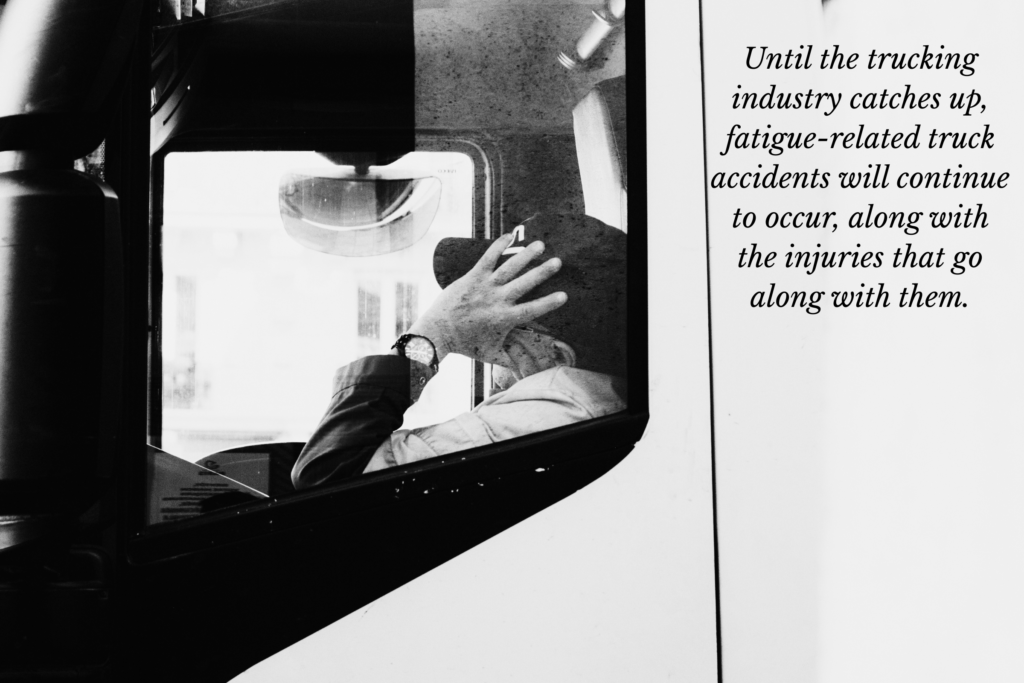
If you’re in an accident with a truck, this matters. Aviation has set high standards for fatigue management, proving that trucking can go much further to ensure safety. Until the trucking industry catches up, fatigue-related truck accidents will continue to occur, along with the injuries that go along with them.
Fatigue is a Major Factor in Transportation Accidents
The Code of Federal Regulations, which sets rules for aviation, defines fatigue this way:
“Fatigue means a physiological state of reduced mental or physical performance capability resulting from lack of sleep or increased physical activity that can reduce a flightcrew member’s alertness and ability to safely operate an aircraft or perform safety-related duties.”
The same can be said for truckers. Drowsiness and fatigue are common, not just for pilots but for anyone in the transportation industry. Contributing to fatigue are:
- Long hours
- Irregular schedules
- Working at night
- Environmental factors that require focus (such as bad weather or low visibility)
- Monotony
And as the above definition describes, fatigue has both physical and mental consequences. Some things that are affected by fatigue are:
- Reaction time
- Judgement and decision-making
- Attention and focus
- Coordination and motor skills
- Memory and cognitive processing
- Situational awareness of surroundings (road conditions, speed, other vehicles)
- Visual perception (blurry vision, depth perception)
- Microsleep episodes (nodding off)
No one should drive when they’re sleepy. If you’ve ever fallen asleep behind the wheel, it’s scary. And one in 25 drivers says it’s happened to them. When flying a plane or driving a big rig, the chances of fatigue are greater and more dangerous. If you’re hurt in an accident because someone was impaired by fatigue, you deserve compensation.
Rest Requirements for Pilots and Truck Drivers
Rules for pilots are set by the Federal Aviation Administration (FAA):
- Pilots can fly no more than 13 hours when they are part of a 3-person flight crew. The limit goes up to 17 hours for a 4-person crew.
- They must have 10 hours of off-duty time before each flight.
- There is also a rule that they can’t exceed 100 on-duty hours in 672 consecutive hours, or 1000 hours in 365 consecutive days.
Truck driver regulations are up to the Federal Motor Carrier Safety Administration (FMCSA):
- Truckers hauling materials are allowed a maximum of 11 hours behind the wheel.
- They must take a 30-minute break after 8 hours.
- At least 10 hours of rest before each trip.
- Rules are different for buses, with a 10-hour behind-the-wheel limit after an 8-hour rest.
All of these are basic rules, and there are some exceptions. For example, pilots get additional rest time to acclimate to different time zones. And truckers who stay within a 150-mile radius can drive for 12 hours.
Exceeding these FAA or FMCSA limits can be a sign of negligence if there is an accident.
The Importance of a Fatigue Risk Management System (FRMS)
To prevent fatigue accidents, transportation companies often adopt Fatigue Risk Management Systems (FRMS). These provide a regulatory framework for dealing with fatigue, making sure that employees stay within the legal limits. But each industry has a different approach.
In general, aviation’s approach is science-based and data-driven. Their regulations often go beyond basic compliance.
In the trucking industry, drivers are expected to follow the regulations. But the decision to implement a formal FRMS is left up to individual companies.
The table below outlines the differences between the two industries regarding fatigue.
| Aviation | Trucking |
| Governed by the Federal Aviation Administration (FAA). | Governed by the Federal Motor Carrier Safety Administration (FMCSA). |
| Have mandated flight time and rest requirements. Fatigue is explicitly treated as a safety hazard. | Must follow Hours of Service (HOS) rules for driving time and breaks, but there are exceptions, such as allowing short-haul truckers to exceed HOS limits. |
| Have advanced systems to monitor and assess fatigue, modeled on military readiness research. Investigations use cockpit voice and flight data. | Monitor HOS either with electronic logging devices (ELD) or a manual time record. Telematics can analyze unsafe driving patterns for truck accident reconstruction, but are optional. |
| Have established programs for reporting fatigue. | No standardized fatigue-specific reporting. |
| Pilots are protected from retaliation if they refuse work due to fatigue. | Jobs are often pay-per-mile, so drivers suffer if they stop work due to fatigue. |
Fatigue Risk Management Systems help companies make sure everyone is following the rules to avoid fatigue-related accidents, but they are far more common in airlines than in trucking companies.
Why is this important if you’re in an accident with a truck? As a transportation accident lawyer in New Mexico, Kane Personal Injury’s job is to prove causation and negligence. Many aviation-style fatigue management tools are available to trucking companies, but are rarely used. This can strengthen the argument that the company did not take reasonable safety measures when their exhausted drivers caused your accident.
What Truck Companies Can Learn from Airlines About Fatigue
The trucking industry—and the victims of truck accidents—could benefit if more trucking companies treated fatigue the way that major airlines do. And some of the large carrier companies do have FRMS protocols and good safety records.
Some strategies that can make trucks safer on the roads include:
- Driver education
- Incentives for safe driving
- Wearables (like smart watches) that track drowsiness and alert drivers
- Cab alert systems that detect erratic driving
- AI route planning
But unlike aviation, the trucking industry is made up of many small companies and independent owner/operators dealing with slim profit margins. Many resist spending the money on safety measures like EDLs and telematics. They may follow basic federal mandates, but resist any additional oversight.
A lack of safety measures can lead to sloppy time tracking and pushing drivers to work past the point of fatigue. This can be extremely dangerous and negligent, resulting in serious accidents.
How An Attorney with Aviation Knowledge Can Help in Your Truck Accident Case
Delivery deadlines, getting paid by the mile, and the isolation of long-haul trucking all make fatigue a common problem for truckers and a cause of accidents. Add in bad weather, dangerous roads, and 80,000 pounds of cargo, and those accidents can be catastrophic.
Victims will want an FMCSA investigation attorney who can discover if the driver was over their hours of service limit. Someone who also knows FAA and aviation rules can be an added bonus.
Samuel I. Kane is a transportation accident lawyer in New Mexico who is also a licensed pilot. When it comes to cases where fatigue played a role, he applies his expertise in aviation safety to interpret logs, driver data, and scheduling failures. His specialized knowledge allows him to outline the reasonable safety standards that should be in place and prove negligence when trucking companies fall short.
If you have been hurt in an accident with a truck, there is a good chance that fatigue was involved. Kane Personal Injury’s unique skill set with both trucking and aviation can help you get the compensation you deserve. Contact us today.